


Deprecated: Optional parameter $output declared before required parameter $atts is implicitly treated as a required parameter in /var/www/clients/client0/web46/web/wp-content/plugins/td-composer/legacy/common/wp_booster/td_wp_booster_functions.php on line 1740

Deprecated: Optional parameter $depth declared before required parameter $output is implicitly treated as a required parameter in /var/www/clients/client0/web46/web/wp-content/plugins/td-cloud-library/includes/tdb_menu.php on line 251

Deprecated: Optional parameter $caller_id declared before required parameter $channel_that_passed is implicitly treated as a required parameter in /var/www/clients/client0/web46/web/wp-content/themes/Newspaper/includes/wp-booster/tagdiv-remote-http.php on line 124

Deprecated: Optional parameter $caller_id declared before required parameter $channel is implicitly treated as a required parameter in /var/www/clients/client0/web46/web/wp-content/themes/Newspaper/includes/wp-booster/tagdiv-remote-http.php on line 146
Blog - Page 1841 of 2782 - Virus Reports London Escorts sunderland escorts asyabahis.org dumanbet.live pinbahiscasino.com sekabet.net www.olabahisgir.com maltcasino.net faffbet-giris.com asyabahisgo1.com www.dumanbetyenigiris.com pinbahisgo1.com sekabet-giris2.com www.olabahisgo.com maltcasino-giris.com faffbet.net betforward1.org www.betforward.mobi 1xbet-adres.com 1xbet4iran.com romabet1.com www.yasbet2.net www.1xirani.com www.romabet.top www.3btforward1.com 1xbet https://1xbet-farsi4.com بهترین سایت شرط بندی betforward

Global Statistics

All countries
695,781,740
Confirmed
Updated on September 26, 2023 9:06 pm
All countries
627,110,498
Recovered
Updated on September 26, 2023 9:06 pm
All countries
6,919,573
Deaths
Updated on September 26, 2023 9:06 pm

Global Statistics

All countries
695,781,740
Confirmed
Updated on September 26, 2023 9:06 pm
All countries
627,110,498
Recovered
Updated on September 26, 2023 9:06 pm
All countries
6,919,573
Deaths
Updated on September 26, 2023 9:06 pm
Home Blog Page 1841

Live Cyclone Amphan Updates: India and Bangladesh

0
Live Cyclone Amphan Updates: India and Bangladesh

The authorities acted quickly to move people from the cyclone’s path, but worried they might be putting them into the path of the coronavirus.

Video

Video player loading

Cyclone Amphan hit India’s coast as the country and neighboring Bangladesh are struggling with coronavirus infections. The storm also caused floods in Sri Lanka.CreditCredit…Reuters

Bridges swept away. Phones and electricity out. Early reports of death.

An ambitious evacuation effort and the weakening of Cyclone Amphan as it swirled onto land seems to have spared many lives.

But the authorities in India and Bangladesh were waiting for daybreak to see just how bad things are.

“The next 24 hours are very crucial,” said Mrutyunjay Mohapatra, India’s chief meteorologist, The Associated Press reported. “This is a long haul.”

The cyclone washed away bridges connecting Indian islands to the mainland and left many areas without utilities, the West Bengal chief minister Mamata Banerjee told reporters Wednesday evening. Ms. Banerjee said that while a clearer picture of the devastation would emerge by Thursday, there had been at least seven deaths, the A.P. reported.

Just a few days ago, meteorologists were calling the cyclone one of the most dangerous storms in decades.

Cyclone Amphan slammed into India’s coast on Wednesday afternoon, knocking down huge trees, bringing ropes of rain and sending millions of poor villagers rushing into evacuation shelters.

The emergency response was complicated by the coronavirus.

India and Bangladesh are still under lockdown, and many people living along India and Bangladesh’s swampy coast were fearful of packing into crowded shelters where the chances of infection could be much higher.

“First Covid-19, now cyclone,” said a headline on the Indian broadcaster NDTV on Wednesday evening.

The storm, fueled by the warm waters of the Bay of Bengal, made landfall around 4 p.m. near the Indian town of Digha, on the eastern coast, with wind speeds between 100 and 115 miles per hour.

Indian television channels showed images of frothy waves cresting sea walls and trees snapping into pieces. The winds blew apart some buildings, and Indian news media reported that a child died after a mud wall collapsed on top of him.

An aid agency official in Cox’s Bazar in Bangladesh, near where a million Rohingya refugees are marooned in muddy camps, posted videos of heavy rain streaming down between apartment buildings.

The storm passed over the ecologically fragile Sundarbans region, between the Indian state of West Bengal and Bangladesh’s Hatiya Islands. The region is home to many rare animals, including Bengal tigers.

It was also predicted to pound Kolkata, one of India’s biggest and most historic cities, the first major capital during British colonial times and full of old and delicate buildings. On Wednesday evening, reports on social media and television stations showed countless electrical wires and lamp posts short-circuiting in the streets of the city, and winds so strong that reporters struggled to remain on air.

India and neighboring Bangladesh are both struggling with rising coronavirus infections. Just this week, India reported it had crossed 100,000 infections.

Image

Credit…Dibyangshu Sarkar/Agence France-Presse — Getty Images

What do you do if your shelters pose a danger of their own?

That was the problem faced by officials preparing for the onslaught of Amphan.

South Asia is no stranger to cyclones, but this one had an added challenge: protecting people from becoming infected by the coronavirus while they are packed inside emergency shelters.

Around three million people in India and Bangladesh have been evacuated to cyclone shelters. Some of these structures are huge, holding up to 5,000 people.

While some were being kept only half full, because of concerns about social distancing, others are wall-to-wall with people.

And in India, there are fewer shelters available than for past storms. Hundreds were repurposed two weeks ago, before the cyclone was even on India’s radar screens, and turned into Covid-19 quarantine centers.

In Nedhuali, a village on India’s coast, police officers moved from mud house to mud house with folded hands, urging residents to get to the emergency shelters. But many villagers refused, saying they were afraid of becoming ill.

“We are fighting a war on two fronts,” said Rajesh Pandit, a police officer in that area. “First to evacuate people and then to be make sure that they don’t catch the infection.”

Bangladesh has more than 4,000 dedicated cyclone shelters. On top of that, the authorities have cleared out schools and government buildings to house more than two million people who are expected to evacuate.

“Many people are not aware about social distancing and hygiene,” said Sharif-ul-Islam, a government official in Bangladesh. “Our priority is to educate them and try to keep them safe.”

Image

Credit…Suzauddin Rubel/Agence France-Presse — Getty Images

For the past few days, Abdur Rahim, a Rohingya refugee, has barely slept.

As Cyclone Amphan headed toward Bangladesh, Mr. Rahim and about one million other Rohingya Muslims living in refugee camps along the coast were preparing for the worst.

Residents stockpiled food and wrapped personal documents in plastic. Humanitarian groups placed inflatable boats in the camps to prepare for storm surges of several feet. Government officials secured steep, muddy hillsides with concrete and bamboo to prevent landslides from the rain.

Mr. Rahim, 39, who lives with his wife and six children in the Kutupalong refugee camp, near the town of Cox’s Bazar, said he and his neighbors were terrified to leave their homes.

With wind gusts expected to reach 100 miles per hour, many Rohingya worry that their makeshift tin and tarpaulin shelters could be blown away. And in recent days, the first cases of Covid-19 have been confirmed in the camps, adding another layer of anxiety and danger to relief efforts.

Snigdha Chakraborty, the Bangladesh director for Catholic Relief Services, said the coast’s limited health facilities and poor infrastructure suggested “a grim picture for the days ahead.”

“There are no evacuation shelters in the camps and we are worried about damage from flooding, wind and risk of Covid-19 as resources are stretched,” she said.

Image

Credit…Reuters

“A cyclone is coming. Get to the shelters.”

That was the stark warning the Indian authorities gave last year to residents of India’s poorest states, where millions of people live jammed together in a low-lying coastal area in mud-and-stick shacks.

Residents of the state, Odisha, heard the message not once but over and over via text messages, TV ads and public address systems. And they listened.

By the time Cyclone Fani slammed ashore, an estimated one million people had been moved to safety.

Experts hailed the achievement, the result of a meticulous evacuation plan, not least because it was accomplished in such a poor state in a developing country.

But the authorities had been sobered by past tragedies.

Twenty years earlier, when a powerful cyclone hit the same area, wiping out villages and killing thousands.

Last year, the government appeared determined not to let history repeat itself. And this time, again, as Cyclone Amphan bore down, the authorities moved to get them out of the way.

Image

Credit…Rupak De Chowdhuri/Reuters

Kolkata, one of India’s biggest and most historic cities, filled with graceful buildings hundreds of years old, sits directly in Cyclone Amphan’s path. By Wednesday afternoon, the streets were deserted.

“No one is out there,” said Jawhar Sircar, a retired government administrator who lives in the city’s Gariahat neighborhood. He said the skies were gray and that it was drizzling outside, “like London.”

The precautions taken to reduce the spread of the coronavirus may have helped the city ready itself for the storm. Many of the 15 million or so people who live in the Kolkata metropolitan area had already been staying at home, obeying India’s lockdown rules.

Still, Kolkata officials were not taking any chances. They cleared out storm drains, shored up slum shanties with bamboo poles and removed objects like potted plants from roofs and balconies so they wouldn’t turn into missiles.

In Kolkata’s fancier neighborhoods, residents were being told to jam cloth into the rails of their sliding doors and windows — to make sure wind gusts didn’t wrench them open — and to leave their parked cars in gear and with the emergency brake on so they didn’t roll away.

Kolkata served as the capital of British India from 1772 to 1911, when New Delhi was chosen. It is usually spared the brunt of cyclones, as it lies more than 50 miles inland from the Bay of Bengal. “The British wanted safety from the turbulent sea weather,” Mr. Sircar explained.

By Wednesday afternoon, that turbulent weather was headed straight toward the city. Anand Sharma, the director of the India Meteorological Department, told NDTV that the bulk of the typhoon had moved a little further away from Kolkata, but that winds would batter the city until it reached Bangladesh on Thursday morning.

On Indian television, residents shared pictures of fallen lamp posts and trees, and reported that many apartment buildings had been flooded.

Image

Credit…Ismail Ferdous for The New York Times

Experts say that the Sundarbans — the world’s largest mangrove forest, on a vast delta that supports several hundred animal species — could act as a buffer against the cyclone when it strikes, slowing wind speeds and protecting villages from the worst effects.

But around 70 percent of the 4,000-square-mile forest, which spreads across the border between India and Bangladesh, is just a few feet above sea level. Heavy rains and flooding could have deadly consequences for rare animals there, pushing them out of their habitats and into areas populated by humans.

“The Sundarbans will bear the brunt and soften the blow,” said Prerna Singh Bindra, a conservationist and the author of “The Vanishing: India’s Wildlife Crisis.”

Cyclone Amphan poses a particular risk for the region’s few hundred Bengal tigers, one of the largest remaining populations of wild tigers in the world. Habitat loss, hunting and the illegal trade of animal parts have devastated the global population of tigers — now estimated at fewer than 4,000, compared with about 100,000 a century ago.

“Animals both big and small will be affected if the cyclone hits hard,” said Philip Gain, the director of the Society for Environment and Human Development, a nonprofit organization in Bangladesh that works for environmental justice.

Image

Credit…NASA, via Associated Press

What makes a storm a hurricane, a typhoon or a cyclone? It comes down to location. They all refer to tropical cyclones — low-pressure circular storm systems with winds greater than 74 miles per hour that form over warm waters — but different terms are used in different parts of the world.

The word hurricane is used for tropical cyclones that form in the North Atlantic, northeastern Pacific, the Caribbean Sea and the Gulf of Mexico. Typhoons are storms that develop in the northwestern Pacific and usually threaten Asia.

The international date line serves as the Pacific Ocean’s dividing marker, so when a hurricane crosses over it from east to west, it becomes a typhoon instead, and vice versa.

The same storms in the Southern Hemisphere are easier to keep straight. The storm Amphan is moving over the Bay of Bengal, so that makes it simply a cyclone — the same for storms over the Arabian Sea, which is also in the northern Indian Ocean. In the southern Indian Ocean and South Pacific, they are “tropical cyclones” or “severe tropical cyclones.”

All of these cyclonic storms act to regulate the overall climate, moving heat energy from the tropics toward the poles.

Image

Credit…Associated Press

Cyclone Amphan swept over the Bay of Bengal on Monday as the strongest cyclone ever recorded in the region. But by Tuesday a phenomenon called vertical wind shear — the shifting of winds with altitude — had disrupted the storm’s rotational structure, weakening it.

Amphan initially grew powerful because the waters it passed over were exceedingly warm, as high as 88 degrees in parts of the Indian Ocean. Warmer water provides more of the energy that fuels such rotating storms.

As a result of climate change, ocean temperatures are rising, but other factors, including natural variability, can play a role. While it is not possible to say whether any one specific storm such as Amphan was made more powerful by climate change, scientists have long expected that tropical storms like it would increase in strength as the world warms.

That expectation was based on the laws of physics and computer climate models and not on studies of actual storms. But earlier this week, researchers in the United States with the National Oceanic and Atmospheric Administration, using observational data, reported that the likelihood of these kinds of cyclonic storms developing into the equivalent of Category 3 storms had increased by about 8 percent per decade since the late 1970s.

Reporting was contributed by Jeffrey Gettleman, Sameer Yasir, Kai Schultz, Henry Fountain, Jennifer Jett, Hari Kumar and Elian Peltier.

Read More

‘Shady backroom deal’ could swing upcoming Nevada primary election, RNC tells state attorney general

0
‘Shady backroom deal’ could swing upcoming Nevada primary election, RNC tells state attorney general

Together with the Nevada GOP, Republican National Committee (RNC) chairwoman Ronna McDaniel on Wednesday demanded the state investigate what she called a “shady” and potentially illegal “backroom deal” by local politicians that would alter voting procedures ahead of the state’s all mail-in June 9 primary.

In a letter to Nevada Attorney General Aaron Ford, McDaniel and the state party charged that the Democratic-controlled Clark County Commission reached a secretive agreement with state Democrats that could have violated the state’s open public meeting law. The RNC is concerned that the Democrats’ efforts will effectively finance “ballot harvesters,” or operatives who can retrieve scores of ballots from individuals and turn them in. Some states, including Nevada, ordinarily prosecute ballot harvesters; others permit the practice to varying degrees.

Additionally, the RNC asserted, Democrat Party bosses are now “forcing Nevada’s largest county to waste over $300,000 of taxpayer money to mail ballots to all inactive voters.” That break in normal protocol, Republicans warn, would greatly enhance the risk of fraud.

READ THE RNC LETTER

The Clark County District Attorney’s Office, on behalf of the Clark County Registrar of Voters, has filed a joinder that states: “At the direction of local county officials, the Clark County Registrar of Voters is setting up two additional election day voting sites and will mail absent ballots to all registered voters, including inactive voters, at additional expense.”

The new rules came just 48 hours before a trial was set to begin in a lawsuit filed by state Democrats against the Nevada secretary of state, which the RNC was contesting as an intervening party. As part of the lawsuit, Democrats demanded the suspension of provisions of Nevada law that enhance ballot verification.

Marc Elias, an ex-Hillary Clinton lawyer representing Nevada Democrats, specifically called for Nevada to stop throwing out ballots when signatures on voters’ ballots appear different from those on voters’ registrations, saying “lay election officials have never had the necessary expertise” to make an accurate determination.

Elias also demanded that Nevada “require mail-in ballots be sent to all registered voters in Nevada, not just those in an active status.” Elias said that state election law doesn’t distinguish between the two categories of voters. Further, Elias pushed for the state to suspend prosecutions for ballot harvesting, ostensibly for safety reasons during the pandemic.

Using some detective work, the RNC assessed that Nevada Democrats have already implemented some of those measures without disclosing them to the public.

Voters masked against coronavirus line up at Riverside High School for Wisconsin's primary election Tuesday April 7, 2020, in Milwaukee. The new coronavirus causes mild or moderate symptoms for most people, but for some, especially older adults and people with existing health problems, it can cause more severe illness or death. (AP Photo/Morry Gash)

Voters masked against coronavirus line up at Riverside High School for Wisconsin’s primary election Tuesday April 7, 2020, in Milwaukee. The new coronavirus causes mild or moderate symptoms for most people, but for some, especially older adults and people with existing health problems, it can cause more severe illness or death. (AP Photo/Morry Gash)

“Some unspecified Clark County officials voluntarily decided after the suit was filed on April 16—but before the joinder was filed on May 4—to yield to part of the plaintiffs’ demands,” the RNC wrote to Ford. “Yet between those two dates, the only advertised County Commission meeting where commissioners could have discussed those decisions occurred on Tuesday, April 21, 2020. And the agenda for that meeting provides no evidence that the commissioners addressed issues of additional in-person voting places or mail-in ballots during it.”

“We respectfully ask you to investigate under NRS 241.039 whether the Clark County Commissioners violated Nevada’s open public meeting law when they decided, behind closed doors, to capitulate to the plaintiffs’ demands,” the RNC added. “The Clark County Commission took costly, substantial action regarding the June primary without notifying, broadcasting, or allowing citizens to provide their input. To be complete, your investigation should examine not only which unidentified county officials made the decision referred to in Clark County’s joinder, but also when they made that decision, and whether they consulted with outside groups before doing so.”

The RNC continued:” No doubt the governmental defendants in that case—including your office—exchanged emails throughout the weekend before Clark County filed its May 4 joinder. Some of those emails very likely disclose at least in part how Clark County’s decision unfolded. But whether focused on those emails or not, time is of the essence; actions taken in violation of the public meeting law are void, NRS 241.036, yet the primary is scheduled for June 9.”

The furtive move to mail out more ballots was particularly troubling, the RNC said, citing a Fox News report that thousands of ballots have been sent out by the Clark County Election Department to inactive voters – those who have not voted in recent elections, a roster that can include people who either have moved or are deceased – and the envelopes are piling up in post office trays, outside apartment complexes and on community bulletin boards in and around Las Vegas.

HOW BALLOT HARVESTING HELPED DEMS ROUT GOP IN CALIFORNIA

The excess ballots have drawn complaints from local residents who worry that anyone could pick up a ballot off the street and cast a fraudulent vote, as well as from Republican Party officials in the state who see a nefarious motive behind the vote-by-mail system being employed by the Democrat-dominated Clark County Commission.

“What’s going to happen with these things, they’re not secured at all and there are thousands of them just sitting here,” Jenny Trobiani, a postal worker in Clark County, told Fox News that she has seen hundreds of ballots being mailed to inactive voters. “This just seems fraudulent to me, something stinks here.”

Republicans have argued that many states fail to adequately clean up their voter rolls. Last year, California was forced to remove 1.5 million ineligible voters after a court settlement last year when California’s rolls showed a registration of 112 percent.

“The Clark County commissioners’ decision to capitulate behind closed doors is bad enough, but that harm is compounded by the significant monetary costs of these secret changes,” the RNC argued. “Ms. Lorena Portillo, Assistant Registrar of Voters of Clark County, affirmed in an affidavit that the cost for additional printers to be delivered and programed will be $138,997.50; the cost for mailing the additional ballots will be $184,738.01; and that ‘[b]ased on past experience, at least 90% of those’ additional ballots ‘will come back as undeliverable.’ In other words, the additional costs Clark County taxpayers will incur based on the direction that Mr. Gloria received from unnamed county officials exceeds $300,000, with more than $166,000 to be spent on mailings that even county officials expect will not reach their intended recipient.”

The RNC has taken aggressive steps to combat what it sees as an increasing risk of election fraud. Earlier this month, the RNC launched ProtecttheVote.com, a digital platform that the GOP says is part of its all-hands-on-deck effort to “protect against the Democrats’ assault on our elections” as progressives push for sweeping changes, including vote-by-mail and more ballot harvesting, amid the coronavirus pandemic.

The launch comes after the RNC and Trump campaign doubled their legal budget to $20 million after an initial commitment of $10 million in February, saying they wanted to “fight frivolous Democrat lawsuits and uphold the integrity of the elections process.”

WHO IS MARC ELIAS, AND WHY IS HE WORKING TO SUE NEVADA OVER THE UPCOMING ELECTION?

“In battleground states across the country, Democrats are using the coronavirus as an excuse to push through their long-sought partisan agenda, but we are fighting back to protect the vote,” RNC Chairwoman Ronna McDaniel said in a statement to Fox News. “The RNC will stop at nothing to ensure the integrity of our elections is upheld in the face of Democrats’ brazen assaults.  Americans deserve to have confidence in their elections, and we will not stand idly by while Democrats try to sue their way to victory in November.”

That was a message echoed by President Trump in a tweet last month: “GET RID OF BALLOT HARVESTING, IT IS RAMPANT WITH FRAUD. THE USA MUST HAVE VOTER I.D., THE ONLY WAY TO GET AN HONEST COUNT!”

Read More

State Of Emergency In Michigan After Dam Failure And Flooding | NBC Nightly News

0
State Of Emergency In Michigan After Dam Failure And Flooding | NBC Nightly News


Published on May 20, 2020

A pair of dams in Central Michigan failed, sending water gushing into homes and businesses. Some 10,000 people were ordered to evacuate while the state is under a stay-at-home order because of coronavirus.

» Subscribe to NBC News: http://nbcnews.to/SubscribeToNBC

» Watch more NBC video: http://bit.ly/MoreNBCNews

NBC News Digital is a collection of innovative and powerful news brands that deliver compelling, diverse and engaging news stories. NBC News Digital features NBCNews.com, MSNBC.com, TODAY.com, Nightly News, Meet the Press, Dateline, and the existing apps and digital extensions of these respective properties. We deliver the best in breaking news, live video coverage, original journalism and segments from your favorite NBC News Shows.

Connect with NBC News Online!

NBC News App: https://smart.link/5d0cd9df61b80

Breaking News Alerts: https://link.nbcnews.com/join/5cj/bre…

Visit NBCNews.Com: http://nbcnews.to/ReadNBC

Find NBC News on Facebook: http://nbcnews.to/LikeNBC

Follow NBC News on Twitter: http://nbcnews.to/FollowNBC

Follow NBC News on Instagram: http://nbcnews.to/InstaNBC

State Of Emergency In Michigan After Dam Failure And Flooding | NBC Nightly News

Read More

Memorial Day Parties “Prohibited,” L.A. County Health Director Warns

0
Memorial Day Parties “Prohibited,” L.A. County Health Director Warns

With a minor heatwave expected to hit the area over the long Memorial Day Weekend, L.A. County Public Health Director Barbara Ferrer sought to remind residents that restrictions are still in place.

“We’re gonna approach a holiday weekend, and I want to encourage everyone to take some time and celebrate safely,” said Dr. Ferrer. “Many of our beautiful outdoor spaces are open, and we can enjoy them while we practice physical distancing. We can also enjoy our beautiful weather in our own neighborhoods and our own backyards.”

“I want to remind folks that gatherings and events of any kind are nor permitted,” said the director. “Unfortunately, there have been recent parties and gatherings that did result in a number of newly infected people.”

“Being together from a distance is currently our new normal,” she emphasized.

Following Ferrer’s remarks, the County Public Health Department tweeted an update that included the following caution:

“While many outdoor spaces are open, public and private gatherings of any number of people outside of a single household unit are not permitted. Everyone must continue to follow distancing and infection control protocols.”

This comes a day after Malibu residents reported large-scale violations of county-imposed beach restrictions over the weekend.

“Seventy to ninety percent” of those on Zuma Beach did not have masks, Malibu-based journalist and KBUU radio station manager Hans Laetz reported. Local beach gates were “pried open,” parking nightmares abounded and people threw loud parties at night to watch bioluminescence in the waves.

Read More

CDC quietly releases more detailed guidelines for reopening economy

0
CDC quietly releases more detailed guidelines for reopening economy


CBS News


2.65M


Want to watch this again later?

Sign in to add this video to a playlist.

Sign in


Like this video?

Sign in to make your opinion count.

Sign in


Don’t like this video?

Sign in to make your opinion count.

Sign in


Published on May 20, 2020

As all 50 states are starting to lift restrictions and reopen their economies, the CDC has released guidelines about that process. CBS News White House correspondent Ben Tracy joined CBSN to talk about the latest on that plus other developments in Washington.

Read More

A breath away from death: After weeks on a ventilator SF man walks away from ICU, and COVID-19

0
A breath away from death: After weeks on a ventilator SF man walks away from ICU, and COVID-19

It started with a cough. It was just a little one, but Ron Temko tended to cough sometimes, so the family wasn’t worried. By all accounts, everything was normal.

His family could never have anticipated that just a few days later, Ron would be admitted into the intensive care unit at UCSF Parnassus, where he would spend 21 days in a medically induced coma, 34 days on a ventilator and 40 days on a feeding tube. He was hospitalized for over 61 days due to COVID-19 symptoms, during which he could barely talk and had to relearn to walk and sit up by himself. He was a breath away from death.

Concurrently, Ron was being treated for Stage 5 prostate cancer, but he and his wife, Linda Temko, were highly active and avid travelers. Around mid-February, Ron and Linda, both 69, set off for an international trip — they were attending a wedding in South Africa and made a few stops in Europe before and after. At that point, they already knew about the coronavirus, and did their best to be diligent — wearing masks in the airport and on the plane, trying to social distance, wiping down every area before they sat down.

When they returned to their apartment in the Marina district of San Francisco around March 10, everyone was feeling fine — as well as all the people they’d seen abroad — so they decided to shelter in place with their daughter Perri Garner’s family: her husband, Zak, 34, and two children, Mila and Knolls, who all live in San Rafael.

It had been a lovely few days — the family went on walks over to Crissy Field and Ron got to spend time with his newborn granddaughter, who was 3 months old. But the tickle in his throat was growing. On March 16, after Perri, 33, had put the kids to sleep, she asked Ron if she could take his temperature: 100.4. They called his doctor, who told him to call the COVID-19 hotline first thing in the morning.

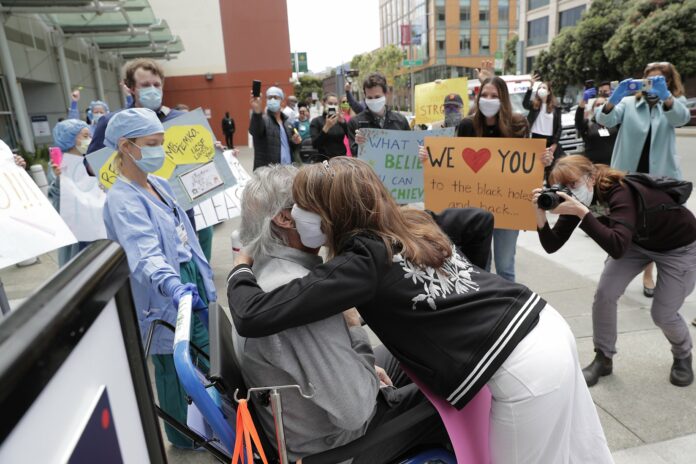
Ron Temko is cheered as he leaves the hospital after cheating death from the coronavirus.

That night, feverish and terrified, he and Linda retreated to bed. She insisted on sleeping with him no matter what.

“I just remember him holding me all night,” Linda said.

On March 17, he tested positive at UCSF Parnassus, and the doctors decided it would be best to keep him there. They put him in a room he joyfully called the “presidential suite,” and FaceTimed his entire family to show them the view. He was wearing a special shirt that Perri had gotten him, reading: “Life is Good.”

For a little while, everything seemed to be under control, Perri said. But then the coughing got worse, and soon, Ron stopped being able to talk because doing so would trigger coughing fits. Shortly after, he called Linda to tell her the news: He was being transferred to the ICU because he needed ventilator support. He told her it was going to get a lot worse before it got better. Linda asked him if he was going to die.

“I don’t know why I asked him that,” Linda said. “But it just popped out of me.”

His voice was resolute when he told her, “No.”

At around the same time, the Garners started feeling sick. Months-old Mila spiked a fever before they even got their test results back, and dad Zak had a fever, too. Perri had muscle aches, headaches and a mild cough. Only their son, Knolls, didn’t present any symptoms.

All of them tested positive for COVID-19.

Except Linda.

Ronald Jay Temko is cheered by family, friends and medical personnel as he is discharged from UCSF Mount Zion Hospital, after being hospitalized for over 61 days with COVID-19 in San Francisco. Calif., on Wednesday, May 20, 2020. Temko was in a coma for 21 days, on a ventilator for 34 days, and had a feeding tube for 40 days. Despite all the odds, he is now up and walking, as mentally sharp as ever, and beyond grateful to be alive. He will now get to walk his daughter down the aisle, hold his new baby granddaughter, and teach his grandson how to play golf.

But in some ways, it was the least of her concerns. She put every inch of her energy toward doing whatever she could for her husband as the doctors had to sedate and eventually paralyze him so he could enter a medically induced coma. The situation was getting critical. But Linda was unwavering as she reminded her family of the rule: No negativity was allowed. It was their mantra.

Ron remained in the coma for three weeks, during which the family never left his virtual side — they sat with him on Zoom calls for hours, hoping that he would hear them, feel them, somehow. They played his favorite music: Supertramp, Fleetwood Mac, the Black Keys. They danced and read messages from everyone in the community who had written to them. And every day, through the pixels of the screen, they reminded him to visualize himself healthy and strong, walking out of there.

The family said that over and over, to remind him — and themselves.

The phrase was a maxim borne out of “Psycho-Cybernetics,” a motivational self-help book by Maxwell Maltz that Ron had long advocated.

“He’s a firm believer in the power of positive thinking — that what you believe you can achieve,” Linda said.

During those three weeks, Linda tried her best to block the negativity, but there were moments where it cracked. It all came to a head on Easter, April 12.

The Garners had already pushed through being sick and Linda was planning to see them, but plans changed when Perri got cold feet, worried about potentially infecting her mother.

“I had a bit of a breakdown then,” Linda said.

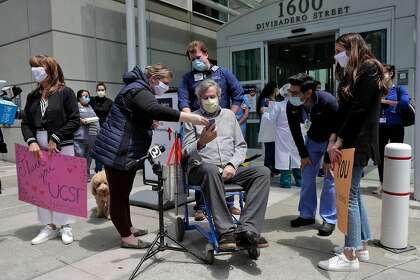
Ronald Jay Temko does a live video feed surrounded by family, friends and medical personnel as he is discharged from UCSF Mount Zion Hospital, after being hospitalized for over 61 days with COVID-19 in San Francisco. Calif., on Wednesday, May 20, 2020. Temko was in a coma for 21 days, on a ventilator for 34 days, and had a feeding tube for 40 days. Despite all the odds, he is now up and walking, as mentally sharp as ever, and beyond grateful to be alive. He will now get to walk his daughter down the aisle, hold his new baby granddaughter, and teach his grandson how to play golf.

She got up the next morning and walked to Sausalito and back — a five-hour journey. She went over to the visitors center, had a granola bar with the pigeons and pelicans, and thought about a picture she’d taken of Ron right there, when they had first started dating. All she wanted was the chance to go back, and take another picture so they could paste them side-by-side.

On April 13, the positivity and the visualizations appeared to be paying off. The doctors started slowly waking Ron up. But then it got worse. When he woke up, he was experiencing a severe case of ICU delirium — he had no idea where he was or what the coronavirus was, didn’t remember checking himself into the hospital and was extremely anxious, which soon became a dark depression. He thought he had been abducted, and wrote disturbing messages about the FBI and guns to his family that he showed them on a piece of paper over Zoom.

“I didn’t know if I wanted to live or die,” Ron said. His legs felt like the trunks of sequoia trees and his entire left side was immobile. His right side was only operating at 30% of its capabilities. “I was a tortoise on its back. And I was sitting there thinking, ‘Is the rest of my life going to be this way?’”

They removed his ventilator on April 27 — he’d been on it for 34 days. And after a sobering conversation with a nurse, he decided to visualize himself healthy, leaving the hospital; he felt determined. It took some time — extensive physical therapy and occupational therapy — but soon he was able to sit on the edge of the bed himself, and then walk again. On May 18, Linda appeared outside of his window with a big sign for their 40th anniversary: It had lyrics from their wedding song, “Make It With You” by Bread.

She came home to a bouquet of flowers he’d ordered her: 40 red roses and two white roses, surrounded by 9 candles — for their immediate family — that Perri had arranged. Linda was characteristically impossible to surprise, but her husband had done it.

After Ron’s two months in the hospital and three weeks in a coma, his family arrived at UCSF Mount Zion, where he’d been transferred, to take him home on Wednesday. Family and friends swarmed the outside, holding up neon signs that glowed under the warm sun: “Strong like Ron” and “We’re so happy you’re home.” Linda and Perri embraced each other. Then the sliding doors opened, and he was there.

Ronald Jay Temko pumps his fist as is cheered by family, friends and medical personnel as he is discharged from UCSF Mount Zion Hospital, after being hospitalized for over 61 days with COVID-19 in San Francisco. Calif., on Wednesday, May 20, 2020. Temko was in a coma for 21 days, on a ventilator for 34 days, and had a feeding tube for 40 days. Despite all the odds, he is now up and walking, as mentally sharp as ever, and beyond grateful to be alive. He will now get to walk his daughter down the aisle, hold his new baby granddaughter, and teach his grandson how to play golf.

The sun shone brightly on Ron as he came out to a chorus of cheers and hollers. A flood of nurses in scrubs and doctors followed close behind, encircling him as he held his heart over his chest and cried softly.

He and Linda thrust their fists in the air at the same time. One of the nurses wiped away tears, and a physician’s glasses fogged up. Perri teared up behind her sign, which read: “What you believe you can achieve.” She told her dad that his granddaughter was here to see him, too.

Linda had tested negative for antibodies, which meant she could potentially still get sick. The night before picking him up from the hospital, she wondered how she should greet him; the doctors had told her that it wouldn’t be a good idea to hug or kiss him, and that he should remain isolated because after two months, he was still testing positive.

But the moment he got within her sight, something clicked in her and she reached over to kiss his cheek.

“I’m onto my second life,” Temko said, dropping his head back in his wheelchair to bask in the sun.

Linda stayed beside him, rubbing his back. She wasn’t leaving.

Annie Vainshtein is a San Francisco Chronicle staff writer. Email: avainshtein@sfchronicle.com

Read More

Orange County reports its highest daily increase in COVID-19 cases, fatalities after 8 die at nursing homes

0
Orange County reports its highest daily increase in COVID-19 cases, fatalities after 8 die at nursing homes

Our European visitors are important to us.

This site is currently unavailable to visitors from the European Economic Area while we work to ensure your data is protected in accordance with applicable EU laws.

Read More

Poison exposure calls surge in Wash. during coronavirus pandemic

0
Poison exposure calls surge in Wash. during coronavirus pandemic

Poison exposure calls surge in Wash. during coronavirus pandemic – KOMO News
Read More

All 50 states have now begun the process of reopening

0
All 50 states have now begun the process of reopening

Stephanie Sy:

For weeks, states have taken steps toward lifting lockdowns, with mixed messages coming from federal authorities.

After much delay, the Centers for Disease Control and Prevention has quietly released a 60-page document with guidance on testing and reopening, but it generally steers clear of language on mandatory rules. It includes cleaning and social distancing recommendations for bars and restaurants, suggests staggered shifts and physical barriers to prevent contact in the workplace, and calls for limited ridership on public transportation, with required face coverings for transit workers.

Schools in areas that meet certain metrics for lower virus transmission are encouraged to space desks at least six feet apart, conduct daily temperature screenings, and serve lunch in the classroom, if they reopen. Notably left out of the CDC document, any mention of how places of worship should resume activity safely.

Overseas, another glimpse of what moves toward normalcy might look like came from South Korea, where high school students returned to class for the first time today.

But, as more countries move to loosen restrictions, in Geneva, the World Health Organization warned the pandemic continues.

Read More

Woman who took hydroxychloroquine for 19 years to treat lupus still contracts coronavirus

0
Woman who took hydroxychloroquine for 19 years to treat lupus still contracts coronavirus

Woman who took hydroxychloroquine for 19 years to treat lupus still contracts coronavirus as she slams President Trump for claiming it helps prevent infection

  • Kim, from Oconomowoc, Wisconsin, tested positive for coronavirus last month
  • The lupus patient believed she was safe because she had been taking antimalarial drug for 19 years 
  • ‘I’m like, “How can I be sick? I’m on the hydroxychloroquine”, she told doctors
  • She also slammed President Trump for claiming the drug prevented infection 
  • Here’s how to help people impacted by Covid-19

By Karen Ruiz For Dailymail.com

Published: | Updated:

A Wisconsin woman who has been taking hydroxychloroquine for 19 years to treat lupus says she still contracted coronavirus despite claims the drug could help prevent infection.

Kim, who did not want to give her full name or show her face, said she was shocked to learn she tested positive for COVID-19 last month.

The Oconomowoc woman told WISN 12 News she had only left her home to go to the grocery store and had believed she was safe after hearing President Trump say hydroxychloroquine could protect people from the virus. 

Scroll down for video 

Kim, who did not want to give her full name or show her face, said she was shocked to learn she tested positive for coronavirus after taking hydroxychloroquine for 19 years 

Despite being on the drug for nearly two decades and taking safety and health precautions, Kim began showing symptoms in mid-April, developing a cough and high fever.

Her condition later worsened to the point where she could no longer breathe and she had to go to the emergency room at Aurora Medical Center where she was told she had COVID-19.  

‘When they gave the diagnosis, I felt like it was a death sentence,’ she told the news station. 

‘I’m like, “How can I be sick? How? I’m on the hydroxychloroquine.”

‘They were like, “Well, nobody ever said that was the cure or that was going to keep you safe”, and it definitely did not.’

Hydroxychloroquine was originally developed to treat malaria but is now used in the treatment of lupus and arthritis. 

The Wisconsin woman, who suffers from lupus, believed she was safe after President Trump claimed the anti-malarial drug (pictured) could help prevent the virus 

On Monday, Trump revealed he has been taking the drug  for a ‘week and half now’

The drug is being tested in trials around the world as a potential treatment for people with severe COVID-19, but no evidence currently exists to show it can prevent patients being struck down with the disease.  

President Trump, however, has repeatedly promoted the drug as a prophylactic, even admitting on Monday he has been taking it for a ‘week and half now.’

Kim revealed she spent seven days in the hospital where she was on oxygen and received plasma, but is now recovering at home.  

She issued a stark warning to people hoping to take the drug as a preventative measure saying hydroxychloroquine will not do anything to protect you from the virus. 

‘You’re not safe taking that medication at all. [Hydroxychloroquine] is not going to prevent anything. You can still get coronavirus,’ she said. 

‘It kind of makes me mad that [Trump] thinks it’s going to do that and is telling the whole world it’s going to do that.’ 

Over the last several weeks, politicians and doctors have been sparring over whether or not to use hydroxychloroquine against the novel coronavirus.

Some say the drug is a ‘game-changer’ while others argue that the evidence is too thin to recommend it now.

Theories that hydroxychloroquine might combat the dangerous effects of coronavirus rely on the same effect it has for lupus sufferers: modulating the immune system.

Lupus is an autoimmune conditioning, meaning the immune systems of those with the disease attack the healthy body, like misguided missiles. 

Hydroxychloroquine is an immune modulator, one of a group of drugs that can turn the immune system on, ramp it up, or act like a reset, making it behave normally. 

For lupus patients, it’s one of the safest drugs to make the body stop attacking itself

HOW HYDROXYCHLOROQUINE TREATS LUPUS BUT DOES NOT RAISE INFECTION RISKS

Originally developed to treat malaria, hydroxychloroquine was later approved by the US Food and Drug Administration to treat lupus as well. 

It was given emergency use authorization as an experimental treatment for coronavirus by the agency in April, after President Trump expressed optimism that it could help treat the infection. 

Theories that hydroxychloroquine might combat the dangerous effects of coronavirus rely on the same effect it has for lupus sufferers: modulating the immune system.

Lupus is an autoimmune conditioning, meaning the immune systems of those with the disease attack the healthy body, like misguided missiles. 

Hydroxychloroquine is an immune modulator, one of a group of drugs that can turn the immune system on, ramp it up, or act like a reset, making it behave normally. 

For lupus patients, it’s one of the safest drugs to make the body stop attacking itself. 

Coronavirus patients who become severely ill also show signs of an over-active immune system, in the form of a ‘cytokine storm’ that drives inflammation out of control, overwhelming their bodies. 

Often, it’s this immune response that ultimately kills COVID-19 patients. 

The hope has been that hydroxychloroquine could help quiet the cytokine storm. 

One of the reasons that hydroxychloroquine is a preferable to many other lupus drugs is that it is not an immune suppressant, or drug that lowers the body’s immune system to stop it from attacking itself. 

Hydroxychloroquine does not significantly raise risks of infections like coronavirus, according to Johns Hopkins University

It does have serious side effects, however. It can cause heart arrythmias, which may be particularly dangerous for coronavirus patients, because evidence now suggests the virus attacks the heart and blood vessels. 

Advertisement

Read More