

London Escorts sunderland escorts asyabahis.org dumanbet.live pinbahiscasino.com sekabet.net www.olabahisgir.com maltcasino.net faffbet-giris.com asyabahisgo1.com www.dumanbetyenigiris.com pinbahisgo1.com sekabet-giris2.com www.olabahisgo.com maltcasino-giris.com faffbet.net betforward1.org www.betforward.mobi 1xbet-adres.com 1xbet4iran.com romabet1.com www.yasbet2.net www.1xirani.com www.romabet.top www.3btforward1.com 1xbet https://1xbet-farsi4.com بهترین سایت شرط بندی betforward

Global Statistics

All countries
695,781,740
Confirmed
Updated on September 26, 2023 9:06 pm
All countries
627,110,498
Recovered
Updated on September 26, 2023 9:06 pm
All countries
6,919,573
Deaths
Updated on September 26, 2023 9:06 pm

Global Statistics

All countries
695,781,740
Confirmed
Updated on September 26, 2023 9:06 pm
All countries
627,110,498
Recovered
Updated on September 26, 2023 9:06 pm
All countries
6,919,573
Deaths
Updated on September 26, 2023 9:06 pm
Home Blog Page 39

Amy Coney Barrett is not ‘wildly’ out of mainstream: Brit Hume

0
Amy Coney Barrett is not ‘wildly’ out of mainstream: Brit Hume

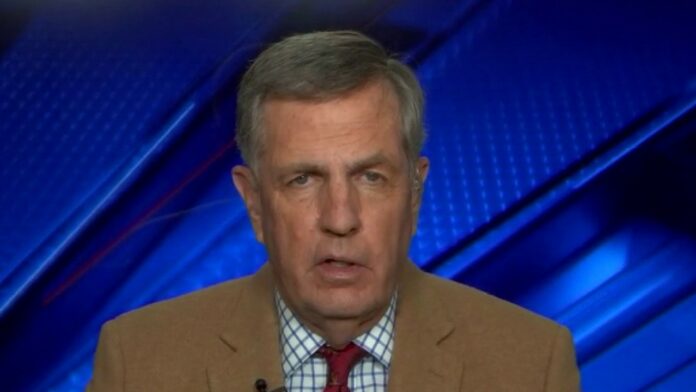
With Judge Amy Coney Barrett‘s name on President Trump‘s short list to fill the vacant Supreme Court seat following the death of Justice Ruth Bader Ginsburg, it’s going to be a “very intense” process, Fox News senior political analyst Brit Hume argued Monday night.

The intensity of the Supreme Court nomination hearings has only grown since the “legally shaky” right to abortion began in Roe v. Wade and the real fear that it might go away has “animated these Supreme Court battles ever since,” Hume told “Fox News @ Night.”

“I go back to Bork and Clarence Thomas and so on and character assassination has been the order of the day for a number of these nominations, particularly when it was felt that this was a justice that might tip the balance of the court or a potential justice that might tip the balance of the court one way or the other or at least to the right,” he added.

“In this case with Ruth Bader Ginsburg, leader of the liberal wing of the court now gone, subject to being replaced by a conservative jurist, I think it’s going to be very intense, indeed,” Hume said.

FAITH AND FAMILY: A LOOK AT JUDGE AMY CONEY BARRETT

He responded to criticism from Senate Minority Leader Chuck Schumer, D-N.Y., who called Barrett wildly out of the mainstream Monday night after the president reportedly met with her earlier in the day. Trump over the weekend said he wanted to pick a woman.

“What Sen. Schumer said, now that’s just a wild exaggeration,” Hume said. “Judge Barrett isn’t someone who is wildly out of the mainstream.”

SENATE SHOULD BE ABLE TO MOVE ‘SWIFTLY’ ON TRUMP PICK TO REPLACE RBG: CARRIE SEVERINO

Barrett’s confirmation as a judge on the U.S. Court of Appeals for the Seventh Circuit in 2017 was contentious, with several Democratic senators questioning her Catholic faith.

When Sen. Dianne Feinstein, D-Calif., said, “The dogma lives loudly within you, and that’s a concern,” Hume explained, “the complaint that you heard from Dianne Feinstein was basically simply this: You take your religious faith too seriously as if that is now a vice in contemporary America.”

Barrett, a former law clerk for the late Justice Antonin Scalia from 1998 to 1999, responded: “It’s never appropriate for a judge to impose that judge’s personal convictions, whether they arise from faith or anywhere else, on the law.”

CLICK HERE TO GET THE FOX NEWS APP

“[The left thinks] people of faith are to be feared,” Hume said, but noted “the distinction between what you would do in your personal life and how you would conduct yourself and the integrity you would display, is one thing, and one hopes that would spill over into your public life but not necessarily into your judicial decisions if you’re a judge.”

Host Shannon Bream added, “But certainly treating people with fairness and with justice and with love and mercy which we all have been given.”

Fox News’ Evie Fordham contributed to this report
Read More

Romney supports holding a vote on next Supreme Court nominee

0
Romney supports holding a vote on next Supreme Court nominee

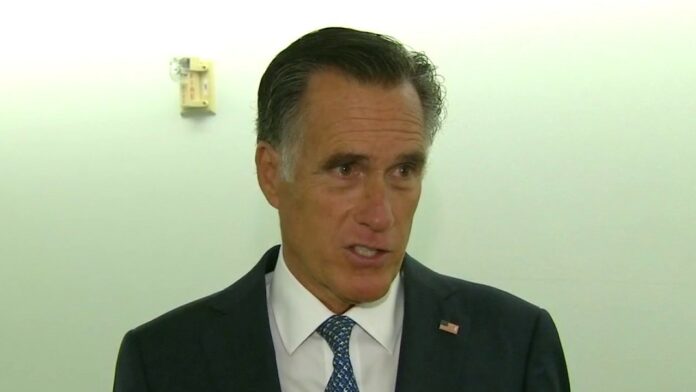
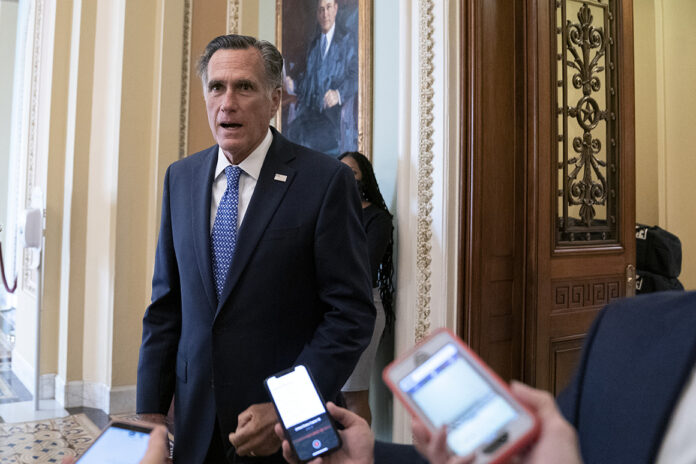
Sen. Mitt Romney. | Stefani Reynolds/Getty Images

Sen. Mitt Romney said he would support a floor vote on President Donald Trump’s Supreme Court pick, essentially clinching consideration of Trump’s nominee this year despite the impending election.

Just two Republican senators have asked for the party to put the brakes on the confirmation. And with a 53-seat majority, Senate Majority Mitch McConnell (R-Ky.) now has the votes he needs to move forward with a nominee to replace the late Justice Ruth Bader Ginsburg.

“I intend to follow the Constitution and precedent in considering the president’s nominee. If the nominee reaches the Senate floor, I intend to vote based upon their qualifications,” the Utah Republican said in a statement.

Romney said he was merely following the law in making his decision rather than taking a position based on the recent blockade of President Obama’s Supreme Court nominee, Merrick Garland, during the 2016 election. Romney said the “historical precedent of election year nominations is that the Senate generally does not confirm an opposing party’s nominee but does confirm a nominee of its own.”

He added that his decision is “not the result of a subjective test of ‘fairness’ which, like beauty, is in the eye of the beholder. It is based on the immutable fairness of following the law, which in this case is the Constitution and precedent.”

Though Romney’s position doesn’t mean Trump’s yet-to-be-named nominee will definitely have the votes to be confirmed, it does mean that McConnell and Trump can move forward without delay.

Other potential swing votes like Republican Sens. Cory Gardner of Colorado and Chuck Grassley of Iowa said on Monday evening they do not oppose considering a nomination. Only Sens. Lisa Murkowski (R-Alaska) and Susan Collins (R-Maine) have said the seat shouldn’t be filled this close to the election.

Read More

Utah’s Mitt Romney prepared to vote on Trump’s Supreme Court nominee

0
Utah’s Mitt Romney prepared to vote on Trump’s Supreme Court nominee

©2020 FOX News Network, LLC. All rights reserved. This material may not be published, broadcast, rewritten, or redistributed. All market data delayed 20 minutes. New Privacy PolicyNew Terms of Use (What’s New)FAQ

Read More

Can we ease motion sickness through mental training?

0
Can we ease motion sickness through mental training?

New research has found that visuospatial training can reduce a person’s experience of motion sickness.

Share on Pinterest
Some researchers suggest that there may be an easy way to reduce motion sickness — by training the brain.

A new study has found that motion sickness can be reduced through visuospatial training, which involves a person manipulating 3D objects in their imagination.

The study, published in the journal Applied Ergonomics, may be particularly valuable given the growing trend toward developing autonomous vehicles, which could induce motion sickness, particularly if a person is engaged in other activities while riding.

Motion sickness can occur in various vehicles, such as cars, buses, trains, airplanes, boats, and theme park rides, and it can also develop while using virtual reality headsets.

In addition to nausea and vomiting, a person with motion sickness may also experience sweating, dizziness, hyperventilation, headaches, restlessness, and drowsiness.

It is not clear what causes motion sickness, but the issue may involve discrepancies among various areas that sense motion — for example, between the inner ear and the visual stimuli that the brain processes.

Doctors often recommend behavioral changes — for example, sitting in the middle of the bus or keeping the eyes fixed on the horizon. Some medications can also help, though they typically make people drowsy.

The researchers who conducted the present study wanted to find more effective ways of reducing motion sickness that did not cause side effects.

They noted that previous research had identified a possible link between motion sickness and visuospatial aptitude, though the precise nature of this link was not clear.

The team found more clues in research exploring the relationship between visuospatial performance and a person’s sex.

This research suggested that males tend to have better visuospatial abilities than females. Previous research has also indicated that females tend to experience motion sickness more than males.

Given the apparent link between visuospatial performance and motion sickness and the likelihood that sex affects both, the authors speculated that people with better visuospatial performance experience less motion sickness.

To test this hypothesis, the team designed a study and recruited 42 participants. They assigned 20 participants, half of whom were female, to driving simulation trials and 22 participants, 60% of whom were female, to on-road driving trials.

Before the trials, the researchers measured the participants’ baseline visuospatial performance. During the trials, they assessed the participants’ motion sickness.

The team then gave the participants pen-and-paper visuospatial training activities to complete for 15 minutes a day over 14 days. These involved activities such as viewing a 3D shape and correctly identifying which of a number of reoriented shapes had been the original shape, as well as paper folding tasks and analyses of spatial patterns.

At the end of this period, the participants again took part in either simulated or on-road driving trials, during which the researchers assessed their motion sickness.

The team found that the participants’ motion sickness had reduced by an average of 51% in the simulated trials and 58% in the on-road trials.

For Joseph Smyth, a research fellow at the University of Warwick, in the United Kingdom, and the corresponding author of the study, “Being able to reduce an individual’s personal susceptibility to motion sickness using simple ‘brain training style’ tasks training is a massive step forward in the development of future transport systems, including autonomous vehicles.”

“Human factors research is all about how we can design products and services that are pleasurable. Motion sickness has, for a long time, been a significant limitation to many people’s transport options, and this research has shown a new method for how we can address this,” he adds.

“I hope that in the future we can optimise the training into a short, highly impactful method. Imagine if when someone is waiting for a test-drive in a new autonomous vehicle they could sit in the showroom and do some ‘brain training puzzles’ on a tablet before going out in the car, therefore reducing their risk of sickness. It’s also very likely [that] this method can be used in other domains such as seasickness for Navy staff or cruise passengers. [And] we are particularly excited about applying this new finding to virtual reality headset use.”

– Joseph Smyth

Read More

Former FDA chief Scott Gottlieb on CDC changing stance on coronavirus guidance

0


Former FDA chief Scott Gottlieb on CDC changing stance on coronavirus guidance – YouTube


Read More

‘It affects virtually nobody’: Trump downplays virus threat to young people

0
‘It affects virtually nobody’: Trump downplays virus threat to young people

President Donald Trump. | Matthew Hatcher/Getty Images

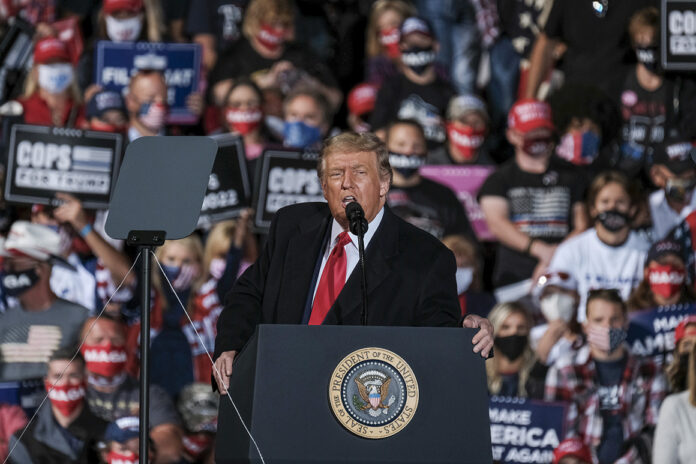
President Donald Trump claimed Monday at an Ohio campaign rally that the coronavirus poses little threat to young people and “affects virtually nobody,” as the number of Americans to have died from Covid-19 climbed toward 200,000 in the United States.

“It affects elderly people. Elderly people with heart problems and other problems. If they have other problems, that’s what it really affects,” Trump told supporters at an airport outside Toledo.

“That’s it. You know, in some states, thousands of people, nobody young. Below the age of 18, like, nobody,” he continued. “They have a strong immune system, who knows. You look — take your hat off to the young, because they have a hell of an immune system. But it affects virtually nobody. It’s an amazing thing.”

“By the way, open your schools, everybody,” Trump added. “Open your schools.”

Americans ages 0-17 make up roughly 8.4 percent of positive Covid-19 cases in the U.S., and roughly 107 Americans ages 0-18 have died from the disease, according to CDC data.

But there are likely much more asymptomatic infections among young people than have been detected, and the rate at which children are becoming infected is increasing — probably because of their return to school and other normal activities.

A recent study from the The American Academy of Pediatrics and the Children’s Hospital Association found that more than 513,000 children in the U.S. have caught the coronvairus since the pandemic began, including 70,630 from Aug. 20-Sept. 3.

And a CDC report released last month indicated that weekly hospitalization rates had steadily increased among children.

The president’s latest remarks contradict the more dire assessments he told The Washington Post’s Bob Woodward in a series of taped interviews conducted earlier this year for the veteran journalist’s latest book on the Trump White House.

“Now, it’s turning out, it’s not just old people, Bob. Just today and yesterday, some startling facts came out. It’s not just older,” Trump told Woodward in a March 19 interview. “It’s plenty of young people.”

In that same interview — recorded at a time when the White House was still publicly dismissive of the coronavirus’ risk to Americans — Trump also acknowledged that he “wanted to always play … down” the virus and acknowledged: “I still like playing it down.”

The president and White House officials have insisted that he was merely trying to project calm in the pandemic’s early days, and Trump said in an ABC News town hall last week that he actually “up-played” the coronavirus “in terms of action.”

More than 6.8 million Americans have become infected with Covid-19 as of Tuesday morning, according to a Johns Hopkins University tracker, and more than 199,000 have died.

Read More

Trump camp keeps pressure on Biden to release list of SCOTUS picks after Ginsburg death

0
Trump camp keeps pressure on Biden to release list of SCOTUS picks after Ginsburg death

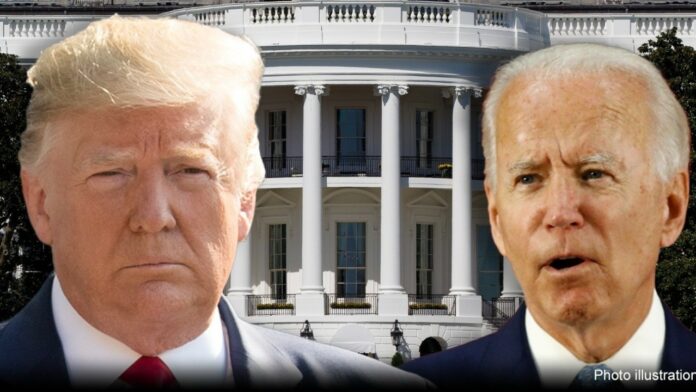
The Trump campaign is keeping pressure on Democratic presidential nominee Joe Biden to release a list of potential Supreme Court nominees should he be elected president in November, saying the former vice president is “hiding” the “radical leftists” he would appoint to the high court from the American people.

President Trump’s reelection campaign, for weeks, has been pressing Biden to release a list of potential picks to the Supreme Court, but with the vacancy left by late Justice Ruth Bader Ginsburg, the campaign is ramping up its calls.

BIDEN CONDEMNS PUSH TO FAST TRACK TRUMP SUPREME COURT NOMINEE AFTER GINSBURG PASSING

“President Trump has been completely transparent by releasing names he’s considering for the Supreme Court four times since 2016,” Trump campaign communications director Tim Murtaugh told Fox News.

“Now that Joe Biden has broken his promise to release his own list, what is he hiding?” Murtaugh continued. “We know he’s a tool of the radical left, so the only answer must be that he doesn’t want Americans to see the radical leftists he would appoint, with judicial histories littered with extremist rulings on issues like abortion, religious freedom, immigration, Second Amendment rights and government regulation.”

Biden, in June, told reporters that he was “putting together a list of a group of African American women who are qualified and have the experience to be on the court.”

“I am not going to release that until we go further down the line in vetting them, as well,” Biden said at the time, without committing to a specific date to roll out the names.

But in the days since the news of Ginsburg’s passing, Biden has shifted his stance, seemingly moving away from releasing a list at all, and instead suggesting he could wait to share who he would appoint to a vacancy on the high court until he is potentially elected president.

During an event over the weekend, Biden slammed the president for his push to nominate a judge to the Supreme Court so close to an election, but also suggested he would make his nominations to the court on a bipartisan basis.

GRASSLEY DEMANDS BIDEN RELEASE LIST OF SCOTUS PICKS 

“Finally, and perhaps most importantly, if I win, I will make my choice for the Supreme Court—not as part of a partisan election campaign—but as prior presidents did,” Biden said over the weekend. “Only after consulting Democrats and Republicans in the U.S. Senate—and seeking their advice before I ask for their consent.”

He added: “As everyone knows, I have made it clear that my first choice for the Supreme Court will make history as the first African American woman justice.”

PELOSI DOESN’T RULE OUT IMPEACHMENT TO STOP TRUMP SCOTUS NOMINATION

Meanwhile, hours after Ginsburg’s passing Friday night, Senate Majority Leader Mitch McConnell, R-Ky., vowed that a Trump nominee to the Supreme Court to fill her vacancy “will receive a vote on the floor of the United States Senate.”

The president went on to urge Republican senators to act and confirm a potential nominee “without delay,” and said on Monday he had already narrowed his list of potential nominees to fill Ginsburg’s seat to five people.

The president said that he will make his announcement at the end of the week, following services for the late Supreme Court justice.

“I think it will be on Friday or Saturday and we want to pay respect, it looks like we will have services on Thursday or Friday,  as I understand it, and I think we should, with all due respect for Justice Ginsburg, wait for services to be over,” the president said.

The president’s campaign, in turn, said that “the Constitution is clear.”

“The president selects a nominee and the Senate provides advice and consent,” Murtaugh told Fox News. “Those are the rules, and they are the only rules.”

He added: “The president will perform his constitutional duties and make a selection and we hope that the Senate takes it up.”

The president’s shortlist is believed to include Judge Amy Coney Barrett from the U.S. Court of Appeals for the Seventh Circuit, Judge Barbara Logoa of the U.S. Court of Appeals for the 11th Circuit, and Judge Allison Jones Rushing of the U.S. Court of Appeals for the 4th Circuit, among others.

“The president has released his list of names, showing complete transparency,” Murtaugh said, referring to the list Trump released from the White House earlier this month of more than 20 additional individuals he would consider appointing to the high court — including three GOP senators. “But Joe Biden will not do the same, because, once again, he is hiding things from Americans.”

Read More

Republican governors took longer in making masks a requirement

0
Republican governors took longer in making masks a requirement

A study has found that Republican governors waited longer than Democratic governors to issuing mask-wearing mandates as a preventive measure against COVID-19.

Share on Pinterest
Preliminary research looks at the links between state governors’ political alignment and how long it took to mandate face masks in their respective states.

Christopher Adolph, of the University of Washington (UW) in Seattle, is the lead author of the new study, which is part of the UW COVID-19 State Policy Project. He states:

“Wearing masks in public places is one of the easiest ways to reduce transmission of the coronavirus, and clear, consistent mandates are one of the best tools we have to get everyone to wear masks regularly. Our team has been tracking mask mandates covering indoor public spaces, where the risk of transmission is highest, and we wanted to know whether adoption was really as partisan as it seemed, or if there were other explanations.”

UW researchers tracked the status of mask mandates in all 50 states, including the timing of their enactment.

When the authors examined the data on August 13, 25 states required people to wear masks in both indoor and outdoor public spaces. In contrast, 14 states did not have a statewide mask mandate. The remaining 11 states had more limited mandates.

The data showed that U.S. states with Republican governors delayed the issuing of mask mandates by an average of 29.9 days compared with states with Democratic governors.

The research paper is available on the preprint server medRxiv and has not yet undergone peer review. The study received funding from the Center for Statistics and the Social Sciences at UW, as well as the Benificus Foundation.

Stay informed with live updates on the current COVID-19 outbreak and visit our coronavirus hub for more advice on prevention and treatment.

The new research follows an earlier study by Adolph’s team regarding the effect of partisanship on mandatory physical distancing rules.

As there is widespread agreement among medical experts that mask wearing helps prevent the spread of the SARS-CoV-2 virus that causes COVID-19, some countries have imposed nationwide mandatory mask wearing to help protect the health of their citizens. In the U.S., however, such decisions are left to individual states.

For the new study, Adolph and his colleagues analyzed several possible influences on the timing of mask-wearing orders. These included the number of COVID-19 cases and deaths in a state. The researchers also considered the average political affiliation of the state’s residents, as well as the party to which the state’s governor belongs.

Two other possible factors — the average education level of state residents and the percentage of people aged over 70 years — seemed to have no appreciable effect on mandates.

The team concluded that the governor’s partisan identification was the most significant driver for the timing of a state’s mask-wearing mandate.

The analysis revealed that Democratic governors were seven times more likely than their Republican counterparts to order mask wearing statewide. This was the case even when the governor identified with a different political party than the average state resident.

To a lesser degree, rising numbers of COVID-19 deaths also affected the decision to mandate masks.

States in which an increasing number of deaths occurred were, on average, 10.5 days faster at issuing mask-wearing orders than other states without such dramatic spikes in COVID-19 mortality.

However, given the novel coronavirus’s 2-week incubation period, COVID-19 deaths are a trailing indicator, reflecting the number of new infections several weeks earlier.

The researchers found that immediate indicators, such as daily tallies of new cases per million and positive diagnoses, had no measurable effect on the timing of mask mandates.

Adolph expresses some surprise that Republican governors have been so resistant to mask wearing. Medical experts are confident that it is a significant factor in risk mitigation, especially when people use it alongside other measures, such as good ventilation. Paying attention to a range of such factors seems to offer the surest means of getting the virus under control and resuming normal activities.

It is only when physical distancing is no longer required that a state’s residents and businesses can finally begin to recover.

Adolph implicates the White House in the divide between the actions of Democratic and Republican governors.

He says: “President Trump spent crucial months deriding masks and refusing to wear them in public. This deepened a partisan divide that few Republican governors have been willing to cross, even as their states’ cases shot up this summer.”

To check your voter registration status, click here to visit the website of VoteAmerica, a nonprofit, nonpartisan organization dedicated to increasing voter turnout. They can also help you register to vote, vote by mail, request an absentee ballot, or find your polling place.

Read More

Secret Service involved in arrest of 2 in Virginia allegedly carrying backpack with gun and ammo near Trump…

0
Secret Service involved in arrest of 2 in Virginia allegedly carrying backpack with gun and ammo near Trump…

Two Virginia residents were arrested on Monday after they were found walking on railroad tracks behind an Ohio airport with a backpack containing a gun and ammunition before President Trump was set to conduct a rally nearby, according to authorities.

John Davison, 38, and Vicki Davison, 33, both of Virginia Beach, were both arrested behind Toledo Executive Airport in Lake Township, Ohio, which is a reliever airport for the city’s main Eugene F. Kranz Toledo Express Airport, where the rally was being held about 20 miles away.

FBI and Secret Service agents were involved in the ongoing investigation into the pair, authorities said, according to Bowling Green’s The Sentinel-Tribune.

LEVIN: SCHUMER UTTERED ‘WORDS OF A FASCIST, OF A BROWNSHIRT, OF A TOTALITARIAN’ AMID SCOTUS BATTLE

The Secret Service didn’t respond to Fox News’ late-night request for comment on the investigation.

Police originally responded to the area after a witness reported that two people had gotten out of a vehicle and were walking on the tracks with shovels and a backpack.

“They were not resisting, but not cooperating,” said Lake Township Police Chief Mark Hummer, according to the paper.

Their backpack contained a Glock pistol with an extended magazine, 200 rounds of ammunition, and four tourniquets, authorities said. At least two shovels and a pitchfork were also allegedly found in their possession.

Hummer added that the rented vehicle the pair had been in had several items “suspicious in nature,” which he described as “odd items, but nothing illegal.”

KLOBUCHAR MOCKED FOR TWEET INADVERTENTLY ARGUING TRUMP SHOULD FILL SCOTUS VACANCY

They were each charged with making terrorist threats; carrying a concealed weapon; inducing panic, and criminal trespassing after their arrests that involved the Secret Service because Trump was at the rally nearby, The Sentinel-Tribune reported.

It wasn’t immediately known if either one had retained an attorney.

CLICK HERE FOR THE FOX NEWS APP

Hummer said John Davison had been cited Sunday night by police in nearby Walbridge for criminal trespass at their street department.

The Toledo Express Airport recently changed its name to the Eugene F. Kranz Toledo Express Airport.

The Associated Press contributed to this report

Read More

28-year-old Houston doctor dies after battle with coronavirus, family says

0
28-year-old Houston doctor dies after battle with coronavirus, family says

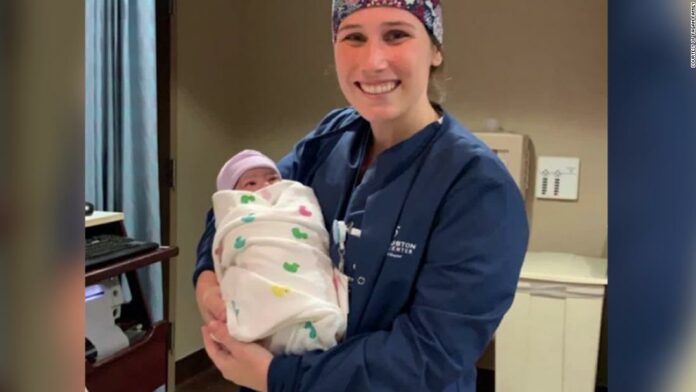
(CNN)Adeline Fagan, a second year OBGYN resident living in Houston, died early Saturday after a couple months-long battle with Covid-19, her family announced in a post on a GoFundMe page established …
Read More